


SpiRobControls (Drexel Zheng Lab)
Staged bringup produced visible directional actuation of a two-cable SpiRob, with relax_ratio = 0.2 and documented motor, cable, and print limits for the next lab iteration.
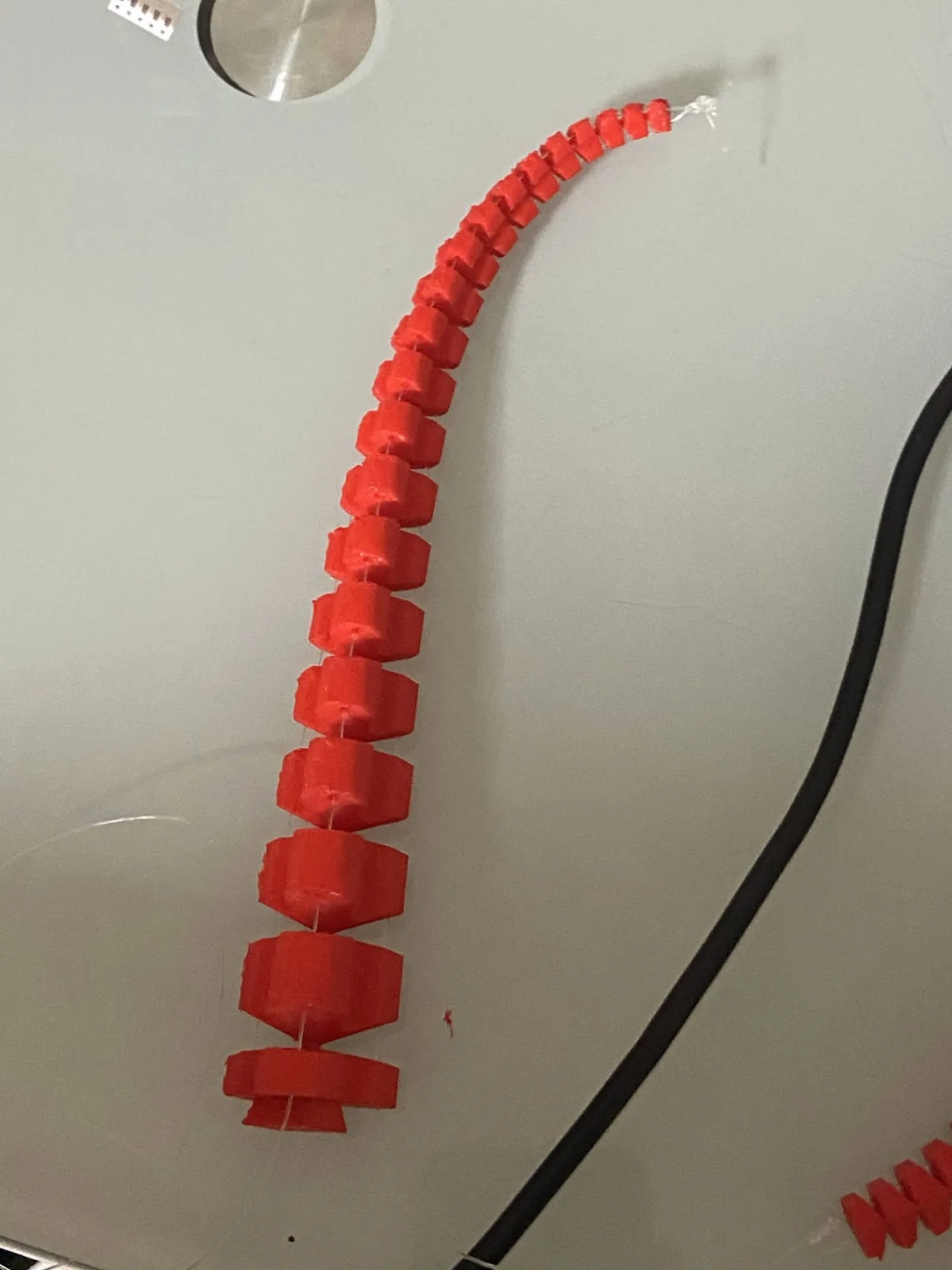
- 1Single-motor tracking
- 2Stall characterization
- 3Coordinated control
The problem
The SpiRob is a logarithmic-spiral soft robot actuated by fishing-wire cables, but the two-cable version did not come with an established control stack. The low-cost stepper motors had limited torque, the fishing wire stretched under tension, and the TPU-70A body could buckle if print settings were wrong. Before coordinated control was even possible, the hardware had to be characterized piece by piece.
What I did
I followed a staged bringup process instead of jumping straight to coordinated motion: single-motor step tracking first, then stall testing to find safe limits, then experiments to tune the passive-motor slack ratio, and finally the coordinated controller. I also printed a mini SpiRob before committing to the full-size TPU-70A print, and built MuJoCo and Isaac Lab environments in parallel so later control work would not depend entirely on physical hardware.
How it works
The production sketch uses AccelStepper and MultiStepper to drive up to three 28BYJ-48 motors at once. The key control value was relax_ratio = 0.2: when the active motor pulls N steps, the passive motor releases 0.2×N steps of slack so the system does not over-tension and stall. That value came out of repeated experiments, not guesswork. The controller accepts both IR remote input and Serial commands, and the fabrication notes document the TPU-70A settings that avoided buckling. On the simulation side, I built both a MuJoCo XML model and a USD Physics cable model for Isaac Sim.
What happened
The hardware achieved visible directional actuation of the two-cable SpiRob, and the documented bringup process gives the next lab iteration a real starting point instead of a blank slate. Just as important, the repo records the system's current limits, motor torque, cable stretch, and missing restoring force, so future design decisions can start from actual evidence.